
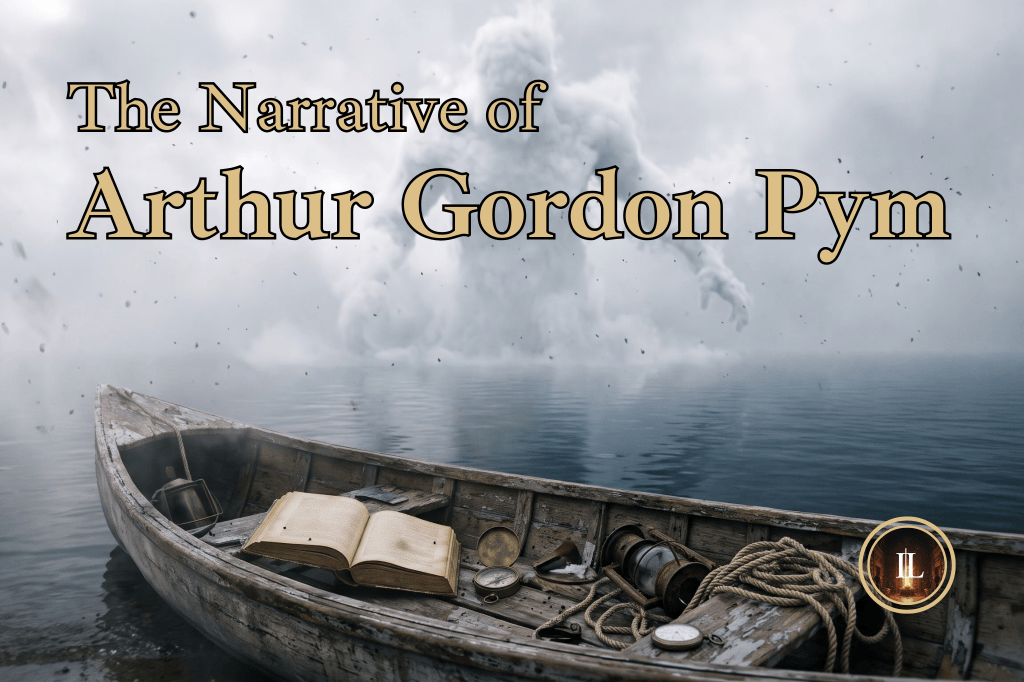
…a narrative, let me here say, which, in its later portions, will be found to include incidents of a nature so entirely out of the range of human experience, and for this reason so far beyond the limits of human credulity, that I proceed in utter hopelessness of obtaining credence for all that I shall tell, yet confidently trusting in time and progressing science to verify some of the most important and most improbable of my statements.
In popular culture, we know Poe as a master of psychological horror. Yet while we read this action-packed maritime adventure novel, one discovers a multi-faceted exhibition of that psyche when stretched to the limits of human endurance. More than fearing the horror, he explores it, seemingly with a clear mind.
As he inspired Sir Arthur Conan Doyle with August Dupin, he surely inspired Melville’s signature sea adventure by illustrating a more illusive and fantastical white phantom. And hundreds of years before Yann Martel writes Life of Pi, he innovates a narrative perspective that inspires questions of truth rather than bickering over fact or fantasy. As he so often asserts, truth is stranger than fiction.
In the preface, Poe, by disguising his own voice as that of his fictional character Arthur Gordon Pym, creates dimensions of reality into which the narrative will flow. Poe could have presented Pym’s story in a third-person narrative form, but chooses to maintain the first-person perspective, as he does in his short stories and papers. Why? And not only does he choose the first-person perspective from a fictional character, but, in the voice of Pym, he says he will trust Poe, the actual writer now a character in this reality outside of the story, to recount parts of the narrative on his behalf. Why? Just as some consider the plausibility of Sherlock Holmes as a real historical figure due to the narrative perspective of John Watson, perhaps we consider Pym and his experiences as factual due to Poe’s chosen narrative form despite their improbability. The complexity of the narration causes the reader to question reality and, as a result, consider possibilities. Approaching fiction as reality exposes the reader to more truth.
As with Melville: “Call me Ishmael.” Why? Because that’s your name? Or because you don’t want me to know your name so you’re telling me to call you something else? Why enigmatic about your name? Are you avoiding accountability for your tale? If so, why? Is it not true? Do you not stand by it?
A simple statement which opens so many possibilities. Narrative choices can open doors in the readers mind like few other devices can.
Consider Pi’s tale. Like Pym, lost at sea after a shipwreck, but with animals as companions. Does Martel report facts? Or does he expose truths about the experience and reveal how the human psyche processes those experiences? If the latter, who, then, cares about facts when confronted with truths about our condition and celebrating how stories reveal our true selves?
Yes, in Poe’s tale, there is a character named Richard Parker and a pet named “Tiger”.
The plot follows three acts of a repeated pattern. Ambition or adventurous spirit sparks an embarkation, followed by calamity, followed by rescue or escape. Poe spends most of his energies on the calamity portions of the cycles as they expose the mechanations of a mind under extreme distress. He leans on his own worst fear, as he also explores in some of his short stories, of living internment.
I firmly believe that no incident ever occuring in the course of human events is more adapted to inspire the supremeness of mental and bodily distress than a case like our own, of living inhumation. The blackness of darkness which envelops the victim, the terrific oppression of lungs, the stifling fumes from the damp earth, unite with the ghastly considerations that we are beyond the remotest confines of hope, and that such is the allotted portion of the dead, to carry into the human heart a degree of appalling awe and horror not to be tolerated – never to be conceived.
Poe describes the effects of the experience, not simply the facts of it; how it acts as a vacuum removing psychological elements like hope, freedom, and joy which provide a kind of meaning to our experiences. But one need not be buried alive to experience hopelessness, confinement, or despair. Through these cycles, Poe contrasts this horror – which occurs in various capacities throughout the novel – with the open sea, the thrill of discovery, the exercise of human ingenuity, and with the expanse of the world.
The cycles operate like a mania.
Near the end of the novel – which, incidentally, does not have a true ending – and during the end of the third cycle, Pym’s white phantom reveals itself in amidst an environment of polar opposite elements than what one would expect at the southern-most point of the world. A truly dream-like state manifested in physical elements. He has escaped his most recent confinement but not the mania. He has ventured as far as man can go and he still finds his phantom waiting, still haunting him in a new shape and with a horrifying calm. On the brink of the last calamity, finding an essence of primitive fear, Pym finds himself within the deepest recesses of his own mind, from which there is no escape. He’s found his core and we remember what he said earlier in the novel.
My visions were of shipwreck and famine; of death or captivity among barbarian hordes; of a lifetime dragged out in sorrow and tears, upon some gray and desolate rock, in an ocean unapproachable and unknown. Such visions or desires – for they amounted to desires – are common, I have since been assured, to the whole numerous race of the melancholy among men – at the time of which I speak I regarded them only as prophetic glimpses of a destiny which I felt myself in a measure bound to fulfill.
He found what he was looking for. And how did he feel upon discovering his truth? Perhaps we need to take our own journeys to find out.





Leave a Reply