
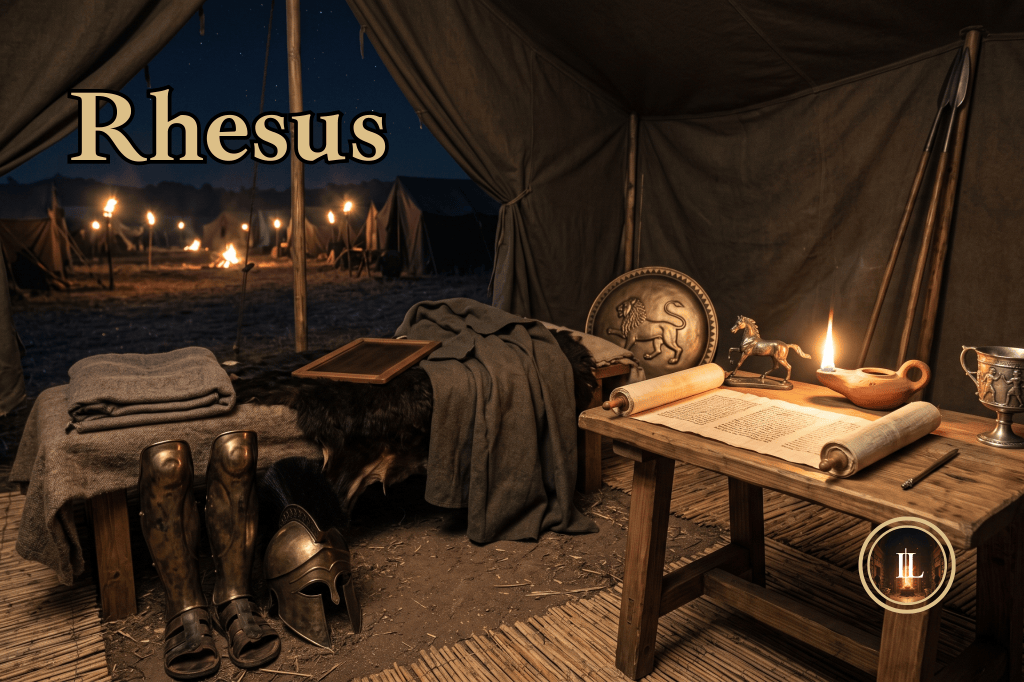
…for he came in friendship and departs in sorrow.
A shorter play, re-imagining the events of a single night between Books 11 and 12 of Homer’s Iliad, likely written by someone other than Euripides, as scholarship argues. While fine, it lacks the punch of other Euripidean tragedies.
The play contrasts over-confidence with stealth and, I would argue, victory and glory. It begins with Hector planning to ambush the Greek camp because of fires lit in the night. His eagerness to end the long war compels him to interpret the fires as the Greek’s preparing to leave Troy. If correct, he feels he must slaughter them during their retreat. Here we have our first question: if Hector’s singluar focus is to reach the war’s end, why not let them leave and celebrate? Why the compulsion to slaughter them from behind as they escape to the sea? What is Hector’s goal?
Before the dawn and execution of his plan, Hector receives Rhesus, a Thracian warrior touted as Achilles’ match, and his armies as allies into the Trojan camp. After their reception, they settle for the night and Odysseus and Diomedes sneak into the camp and, by the beckoning of Athena, kill Rhesus and his army in their sleep. Because of the overwhelming popularity of the Iliad, we think of Achilles and Hector as arch-enemies; warriors who match each other in nobility and brawn. Yet when comparing Hector and Odysseus, the two famous names to represent the warring factions in this play, we think about their tactics. Should we actually applaud Odysseus’ methods to end the war by any means necessary, even if dishonorable or devious, and commend his abandon of glory and “rules of engagement”? Should we blame Hector’s yearning for glory when he should focus on ending the war?
Amidst these questions, an ally falls. In other Euripidean tragedies, calamity comes to a main character, not a footnote in a famous epic poem, and we seek a moral foot-hold to process the outcome. Here, we find ourselves grappling with who to blame. Rhesus’ mother, a Muse, blames Athena who inspired Odysseus’ mission. To my mind, she invokes the most sympathy with her lamentations. The Trojans blame Odysseus and his coniving tactics. But don’t they expect this from him? Rhesus’ charioteer blames the Trojans for betraying their trust and not protecting them while within their hospitality. Regardless of who we blame, the dead remain dead.
A tragic episode without clear moral implications or justice for the blamed, if we can even rightly determine blame. Just another story from Euripides…maybe.






Leave a comment