
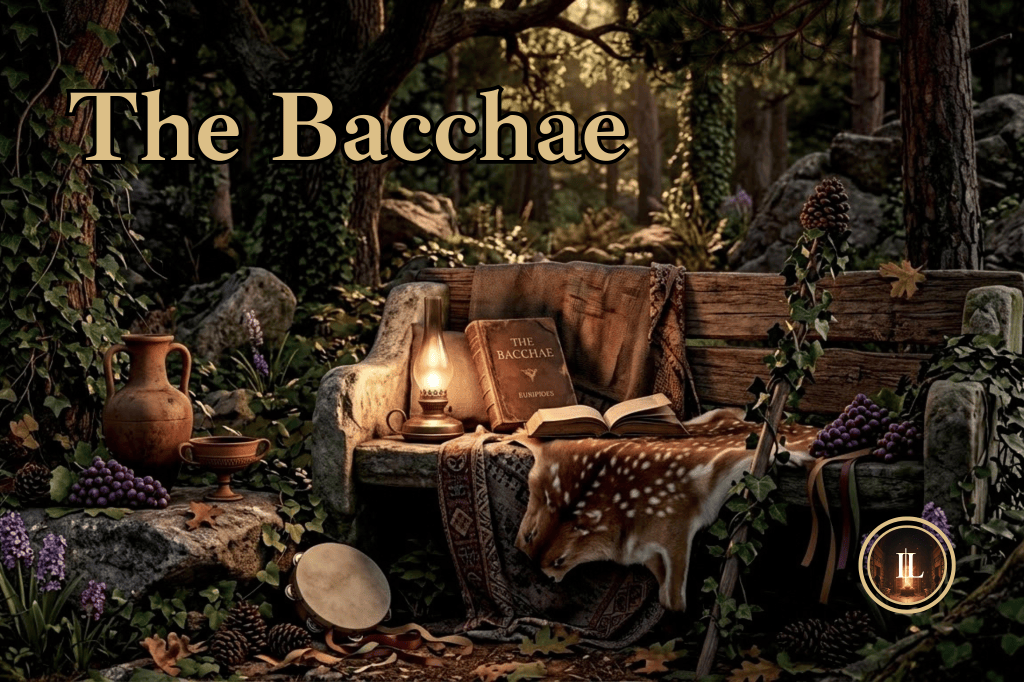
The god, the son of Zeus, delights in feasts, and loves Peace, bestower of wealth, goddess who nurtures young men. Equally to rich and lowly he gives the joy of wine that knows no grief; but he hates the man who has no care for this: by day and blissful night to live the life of blessedness, and in true wisdom to keep mind and understanding apart from men of excess. Whatever humanity at large believes and makes its rule of conduct, that I would accept.
I do not claim to have a broad understanding of Greek mythology or literature, but, to me, Dionysus proves the most intriguing god in the pantheon; and not because he represents wine and debauchery. He is a god who must assert his identity and manipulate the dual identities of the mortals with whom he plays. He elicits a distinction between cleverness and wisdom, as well as nature and civilization. And yet he also highlights the equalizing effect of relief from life’s stresses through wine. He is a god who demands idolization like a discarded bastard entitled to his birthright. And he has the power to throw catastropic temper-tantrums.
Euripides has Dionysus come to Thebes as a foreigner and we learn that his mother’s sisters refute the story of his birth as a fantastic lie. From the beginning, Dionysus is robbed of his honor through the illigitimatizing falsehood of his aunt’s story. Therefore, he asserts his power and identity by burdening women with a madness to leave their newborn babies and sojourn to the woods.
Ironically, we first meet Dionysus in disguise. For one seeking to assert his power and identity, he chooses to do so by pandering to Thebes’ king in the guise of a mortal man; with a fake identity. But as he transforms his identity, he also transforms the identities of Augue and Pentheus, from Queen Mother to animalistic hunter and King to woman; as if repaying Pentheus’ denial by forcing him to be someone else. He not only reverses their identities, but their roles. Whereas Dionysus begins as the captive, he later becomes the captor.
Strangely, Pentheus and Dionysus share qualities. If Dionysus is bent on mortals honoring his godhood, Pentheus is bent on exercising his power. In denying Dionysus, Pentheus asserts his dominion and sense of control over his civilization. Ultimately, the battle of wills can only end in the god’s victory.
Two other points of opposing dualities: nature and civilization as well as cleverness and wisdom. Teiresias and Cadmus say it is wise to honor the gods and Dionysus claims wisdom as Pentheus accuses him of cleverness. Wisdom is to see life’s limitations and humble oneself to their lot in the natural world. Cleverness is hiding the truth of one’s powerlessness by building a facade of power and control. In terms of nature and civilization, men build cities and feel they can accept or deny gods based on their power in a man-made civic system. Dionysus, in opposition, calls his worshippers to wear fawnskins and perform rituals in the woods. Dionysus humbles people from their civil power into animalistic frenzies.
God of madness; exposing and exploiting the two sides of every human, and, like every human, asserting his identity when ignored. Not the god of lightning, war, the ocean, or the hunt…but of human duality, the fight between our baser selves and the better angels of our nature.





Leave a comment