
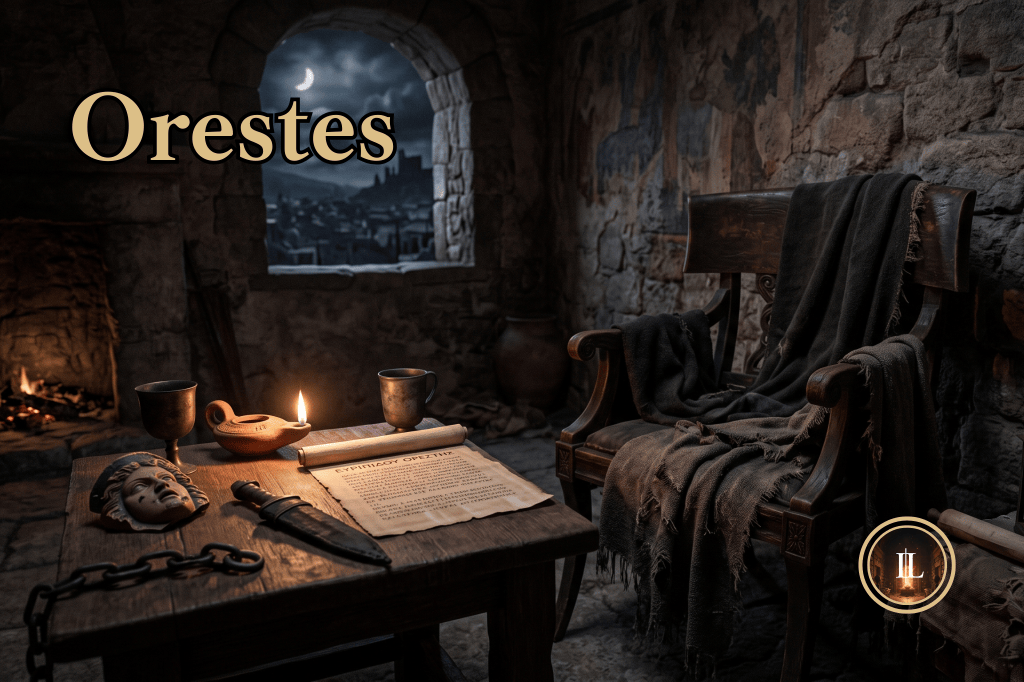
I am unholy as one who killed his mother, yet holy in the other sense, that I avenged my father.
A mythological tradition, yet an impossible situation. In Euripides’ telling of the Orestes myth, he explores the aftermath of the foul deed. All has happened. So what now?
I couldn’t help but associate Orestes with Shakespeare’s Hamlet. An unthinkable family crime; tragedy and evil synchronized in the same nucleus. Both characters ponder their duty in response to the criminal act. They both suffer the throes of madeness and guilt. The atrocity brings an irreconcilable inner impasse and only catastrophe can befall them.
Also, to compare to Oedipus, a modern sense of “original sin” infests Agamemnon’s family. Orestes’ lineage spawns with an offense against the gods which plagues the family from generation to generation. In Orestes, however, Eurpidies specifically focuses in on eye-for-an-eye vengeance, an ouroborial cycle without end.
Consider how Oedipus suffers the consequences of his father’s ignoring an oracle – his family’s “original sin”. We sympathize with Oedipus’ suffering because, though he performs the reprehensible deeds, he does not know what he does. In the Oedipus story, he blinds himself and thus endures the rest of his days as a wretched blind man. Note how Antigone leads the blind Oedipus and how Orestes asks Pilades to “pilot” his steps and and Pylades says he will “bear” Orestes through the town. Where Oedipus offends as an arguably innocent victim, Orestes suffers from an arguably justifiable, though deplorable, action. The unsolvable conundrum.
So do we sympathize with our ancient Hamlet? Shakespeare provides an in-depth psychological exploration before Hamlet’s final action. Euripides assumes his audience knows Orestes’ sin and explores the aftermath of it. Therefore, we may have to concede that we judge each character differently. As to Orestes, he proclaims a one man war against “evil women” but is it arrogance that prompts him to employ supreme judgement over their deeds? He seems like a wild beast, enslaved by passions justified by interminable eye-for-eye vengeance. Even then, in the climactic act with Helen and Hermione, can we qualify those actions as eye-for-an-eye? I would say these are responses to offense and self-preservation. We have sympathized with him to start. Perhaps not by the end. Does he serve justice? Or force his idea of justice to serve him?
I don’t claim that Euripides has a message, or lesson, for his audience. As in many myths, story-tellers seek to understand the cause of human suffering and illogical consequences of evil on “good” men. These tragic Greek characters entangle themselves in horrible deeds and cultural moral innocence, and I appreciate Euripides presenting the question rather than explaining the answer.



 The Immersion Library
Leave a comment