
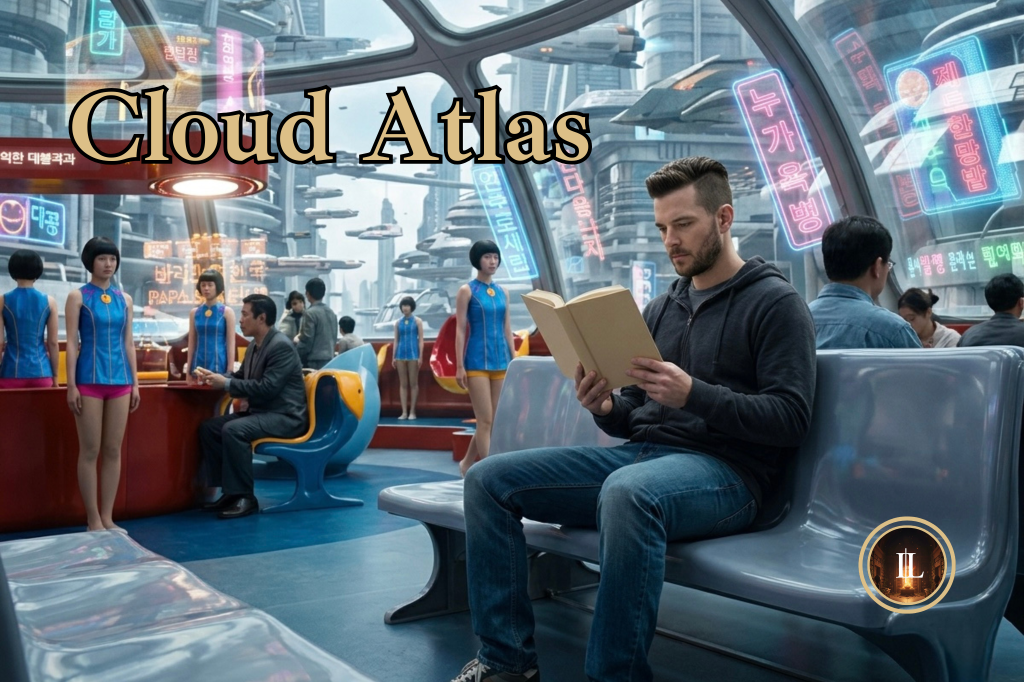
⭐⭐⭐⭐
Rating: 4 out of 5.Our lives are not our own. We are bound to others, past and present, and by each crime and every kindness, we birth our future.
After finally watching the movie, I raced to my local bookstore. Waiting on a shipment through an online retailer simply would not do. I had to start reading Cloud Atlas immediately, even if I did feel like one among the manipulated masses who the publisher hopes will buy the book after watching the movie.
After finishing the film, I remember lavishing the central idea – the connectedness of people’s lives, not defined by a singular birth and death but rather by a non-linear existence unshackled by time or space. I appreciate the artistic license taken by the Wachowski siblings in representing this idea with the same actors playing characters in each storyline. After all, the art of film differs from the art of literature and one must make the most of their chosen artistic vehicle.
Yet each artistic medium wields certain qualities which the other cannot fain to employ. I don’t think I have read a book quite like Cloud Atlas though I’ve come across the idea several times. I believe many writers strive for such excellence in presenting an ancient and universal idea, and, in fact, have thought of framing a book with shifting narrative styles and voices. But few have succeeded with the same profound effect with which Mitchell has succeeded. Could Neal Stephenson interlace his science-fiction mastery with the voice of Daniel DeFoe? Could John Grisham weave James Joyce into his conspiracy narrative? And can they do this without alienating the reader?
Consider the book’s form. Zachary’s post-apocalyptic world, ironically backwards and decontructed, resembling human infancy rather than civilized glory, represents the focal point of the books construction. The book ends with the beginning while it moves chronologically forward and then backwards after reaching the focal point. Within our traditional frame of mind, Mitchell has debilitated linear integrity lending credibility to the non-linear existence of the Soul.
However, I admit I read the book in awe of Mitchell’s talent but felt disengaged at times – like listening to the most proficient virtuoso without feeling moved by the piece. Mitchell fascinated my intellect but, again, at times, failed to charge my spirit. But with any good book, contemplation would connect the idea to a life.
I found the first few subplots random with their characters and stories. Even as I finished the book, I think the Wachowski siblings embellish the connectedness theme more flagrantly than Mitchell does. However, I credit Mitchell for gracefully walking the line between random stories and connected characters. If he blatantly protrays the connections as obviously as the Wachowski siblings do, the reader/viewer might feel isolated from others – thinking that only a select few, divinely gifted with special birthmarks, experience this connection through the ages. Because of the random element, we might consider the possibility of connectivity between all people regardless of historical or divine significance – and think of the birthmark simply as the mark of humanity tattooed on all people.
I also maintain that this randomness helps others to take a more literal interpretation of the idea. If we look for connections among random stories, we don’t necessarily find them only in birthmarks and actors’ faces. We find them in characteristics, personalities and in reactions and promotions of social constructs. Of course, we have witnessed patterns of oppression, revolution, discrimination, love, etc throughout human history. As Tolstoy would argue, these human elements dictate our history far more than any one person’s free choice. This indicates a certain connectedness between people even when separated by aeons.
Not only do our historical patterns indicate a certain connectedness, but our yearning for meaning and belief in life enforce our common bonds. The same 19th century abolitionist would undoubtedly revolt against the Unanimity labor system. And that same revolutionary might delve into the dangerous abyss of investigative journalism to expose the evil plots of powerful men. Should we allow time to dictate how we perceive our existence rather than this obvious and more humane similarity?
Again, I did not find the idea complicated or new. But I found Mitchell’s presentation elegant in its style and beautiful in its use of seemingly insignificant and random people. The birth marks, Frobisher’s possession of Adam Ewing’s diary, Sonmi’s fascination with “The Ghastly Ordeal of Timothy Cavendish”, etc all serve to embellish this idea in a mystical way. As Cavendish said, “As if Art is the What, not the How!” I think Mitchell presented the What with a fascinating and thought-provoking How. Do we need anything else?


 The Immersion Library
Leave a reply to Why am I not reading? | Book Rhapsody Cancel reply