
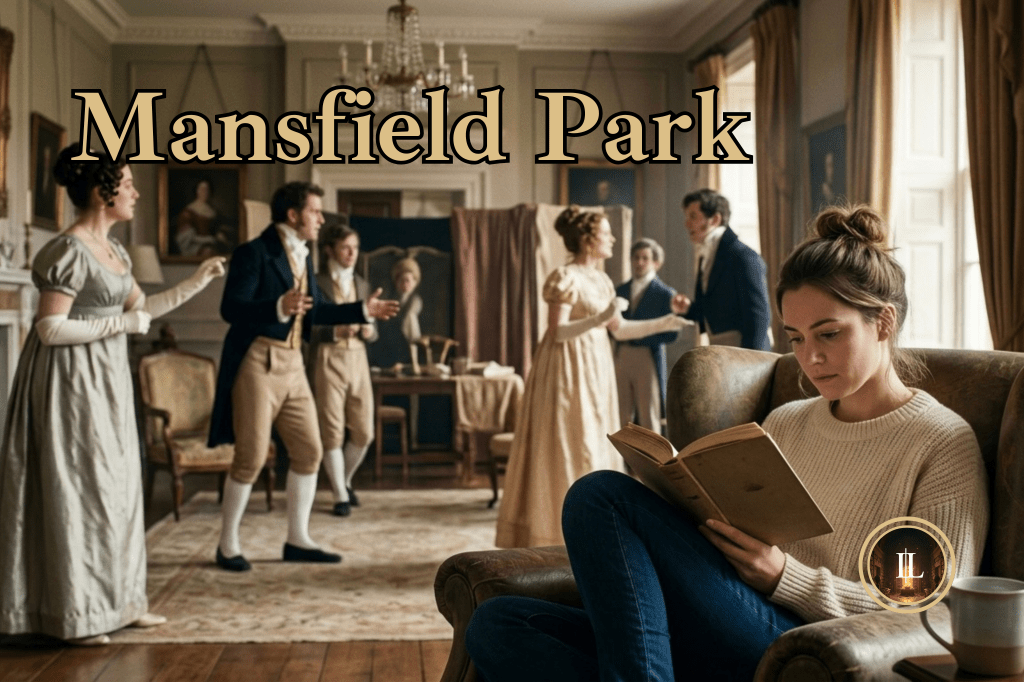
We have all a better guide in ourselves, if we would attend to it, than any other person can be.
I plead guilty. I dearly clutch my idealism like an arrogant college student. I revel in the glory of an awakened conscience, a liberated soul unbound by social norms and accepted traditions. I am the human outsider blessed with the unique gift of uncommon knowledge. I pity the poor robotic minds imprisoned by the grind of apathy.
And yet Mansfield Park frankly stunned me. I witnessed in Austen a mind in transition from what Margaret Drabble called wit to wisdom – what I call a dissatisfaction with the blinding pride of dissent, the compromise between personal liberty and tradition, truth and accepted understanding. The novel exposed Austen’s internal struggle during this transformation, trying to understand her place as a evolving, dynamic and brilliant woman in an unchanging traditional society. It does not in any terms make sweeping generalizations condemning any particular social or economic class using flashes of satirical wit which Austen readers cherish so much. We meet a new Austen, bold in her uncertainty and comfortable in her hesitation to so speedily judge. She does not defend anyone nor cast any family into the fire.
In fact, looking back on the novel, I enjoyed the emotional rollercoaster I felt in reaction to attittudes and actions of the characters. I think many writers suffer the scrupulous expectations of readers who yearn for perfect characters, or, if not, for characters who can perfectly reflect an idea. Fanny, like the maturing Austen, wavers in her own convictions and emotions causing the reader to feel sympathy, frustration, happiness and sadness. Which Fanny should the reader endorse? Yet how can the reader endorse any one Fanny when Austen herself could not? Fanny is bare. She has nothing but her reactions and the conviction to form some set of principles without the privilege of a steady upbringing from which to devise them. We want to see her defend an ideal. We want her to represent the oppression of the poor, the pomp and baseless entitlement of the aristocracy, the defense of match-making or lonely enlightenment of the 19th century independent woman. Every time one adjusts to a particular principle, Fanny changes or, as some might argue, gets in her own way – overthinks and indulges in unnatural self-abasement.
Then finally, after the last noteworthy event in the Fanny’s development, Austen’s idea shines through like light through a window which the reader has spent 400 pages cleaning. In razing the aristocracy, she reinvigorates its legitimacy. She inspires a rememberance of its place in the houase of all people, in every class, with respectable character. Now, Austen consciously chooses to distinguish between the social tradition of aristocracy and those who practice it. I had searched for indications of the life Fanny would choose, the social class with which she would align herself, only to find that the life chooses her according to her character. She only needs to see life and her world for their potential with her in them. She needs to learn about herself. Austen decides that the petty foot races of those who dwell on match-making, parties, dresses, frivolous behavior and unending leisure do not solely define the quality of an entire class of aristocratic peoples. Those who lead a life of principle and defend the tradition of dignity, integrity and respectable character can also fall under the aristocratic label. The reader, or the enlightened college student, does not condemn oppressed classes though they may boast of malicious manipulators of weak resolve and baseless character. Perhaps we ought to reserve judgement for the higher economic classes for similar reasons.
In this regard, Fanny always behaves “aristocratically”, according to her character and principles. If the reader decides, like Austen, that “aristocracy” cannot justly endure a one-dimensional stereotyping based on the behavior of ingrate children, they can see how Fanny, before coming to this realization, could not see her own natural belonging as she endeavors to find her place in society. Other circumstances, most noteably love, draw her to a particular group, not class definitions previously exposed to satirical ridicule. She plants her roots in this class not because of economic or social security prospects but because the life, and the man she marries, fit her character. How can we condemn this? Austen resurrects a forgotten aristocratic dignity which values “the sterling good of principle and temper” and “true merit and true love” above the evolved and insecure prioritization of match-making and social strategy. Of course, these qualities do not exclusively reside within massive manners and inherited wealth yet we must concede how even a popularly and idealistically condemned social class can house these qualities as well. Failure in doing so only serves to stunt our search for knowledge and individual liberation and keep us within a self-constructed character cage much like Fanny’s. I pity the person who bars themselves from happiness based on idealistic indignation or self-alienating stereotyping.





 The Immersion Library
Leave a reply to The Classics Club: Updates, Memes & Journaling | Maple & a Quill Cancel reply