
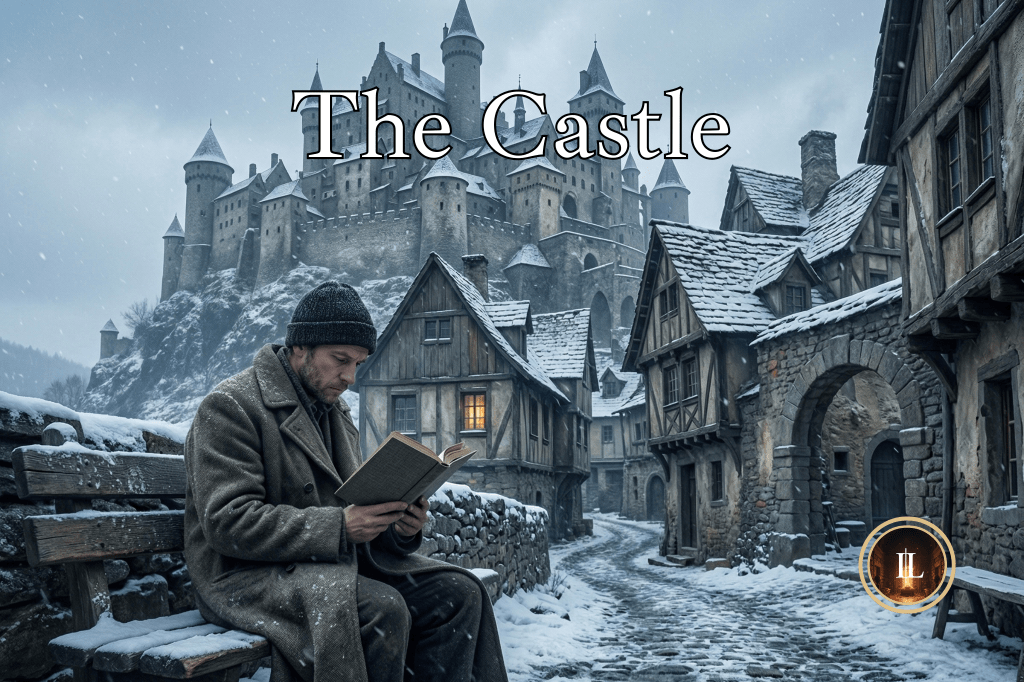
‘Fear of the authorities is born in you here, and is further suggested to you all your lives in the most various ways and from every side, and you yourselves help to strengthen it as much as possible.’
Close your eyes. Go to sleep. Wake up in a wintery village. Lean on people to walk long distances. Force yourself to believe strangers who purport a familiar identity. Convince yourself that you love a random chambermaid. Expertly argue with everyone who expresses their negative impression of you. Are you awake?
Kafka expresses his ideas with peerless effect. To create a compelling fable, writers often abandon realism. Kafka does this by constructing a dream state. He describes elements to which all dreamers can relate; inability to walk or run, convincing oneself of someone’s identity when they look nothing like that person, etc. He could have written his story as a straight reality but, instead, chooses to describe scenes within this dream state. It allows Kafka the freedom to put his subject through an abstract idea without losing the reader’s suspension of disbelief. One then finds themselves reacting to the idea rather than the story.
K., a land-surveyor and stranger to the village, spends the entire story trying to gain access to a Castle that solicites his services. The bureaucracy frustrates the dreamer’s ability to survey the world in which he finds himself surrounded. It also indirectly guides him to a life of servitude; first as a school custodian and then, presumably, as a caretaker in an inn with other chambermaids. When one considers this as a metaphor for a citizen’s experience in real life, they can easily relate to the state’s orchestration of its citizen’s freedom.
I’ll admit. I do not like K. in this novel. He exploits people as tools and disregards their humanity; means to his desired ends. He makes calculated arguments to invaliate others’ impressions of him and deflects acountability for his behavior. And yet, people generally applaud someone’s successes and romanticize their willingness to “do whatever it takes” to reach their goals. Considering the dream state, one may accept how Kafka represents K. in a strictly cerebral capacity. But he also humbles K. and shows how very few people have the capacity to “do whatever it takes”. Who determines the right amount of capacity?
Kafka focuses on the dymanic of the people in this working class village and the bureaucracy of its governing body in the Castle. Consider the structure of the dream – a village and a castle. These elements resemble a kind of fiefdom. How are we to relate to a social system long since abandoned? If one thinks about the mythological implications, one can grasp not only the abstract power dynamic between the two classes but also the very existence of the dynamic. K. cannot reach the Castle and yet it has complete authority and influence over his life and choices; like “fate” or a god-figure. The Castle has no direct contact with him – and even if they do, how does he know they represent the Castle? – as Barnabas and others who go there cannot identify people with any certainty.
The power dynamic is a false construct. It does not exist outside of the villagers’ belief in it. Therefore, who truly holds the power? Bureaucracy itself, as well as its lack of transparency and accessibility by the very people who provide the power, creates an inverse perception which keeps the Castle relevant and people like K., free to survey the world around them, from realizing their potential and stored away in a menial job born of desparation.
Or, perhaps the abstract idea relates to the divine and Man’s inability to reach a divine state by their own methods. The various secretaries may represent earthly priests. But I find little divinity in Amalia’s experience with Sortini.
Ultimately, an abstract dream allows for effectively communicating an abstract idea. If we see the idea so clearly in a dream fable, how can we allow it to continue in the real world?




 The Immersion Library
Leave a comment