
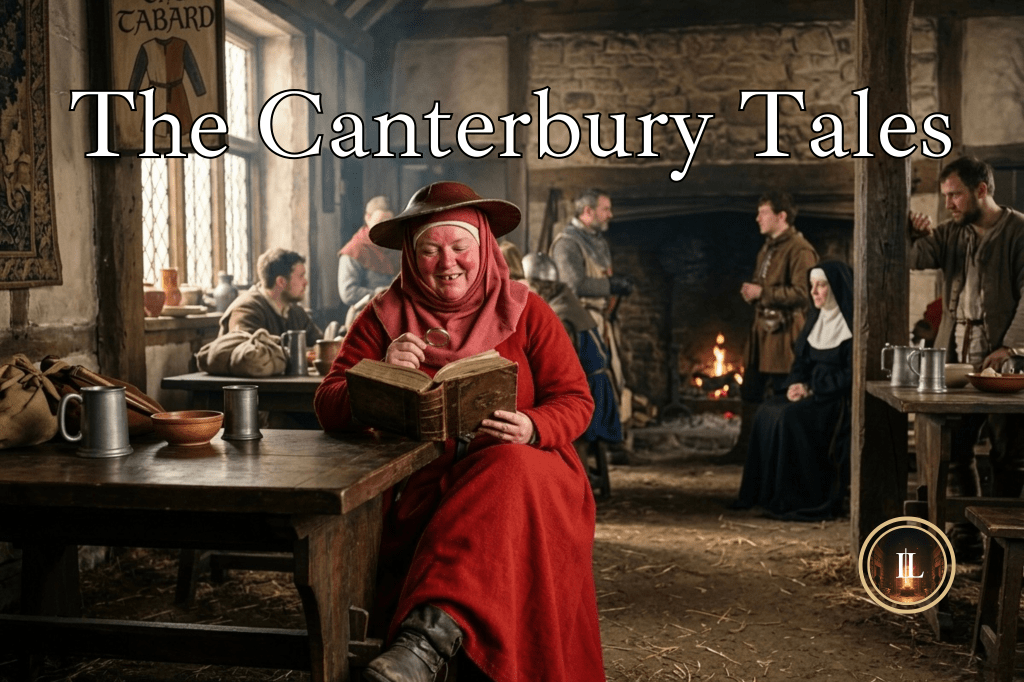
I can’t stop thinking about combinations. Chaucer mixes together characters of different backgrounds, personalities, vocations, beliefs and experiences and has each of them tell a story of their own choosing. While each story differs based on these factors, they reflect common themes of life during the medeival age: gender roles, religion, occupations, etc. As a modern reader, who may perhaps glean insights into life during that era or study the storytelling craft from that time, I can’t help but think about how these combinations of people, backgrounds, stories, characters and beliefs might lead to a common theme of humanity.
I also can’t help but think about purpose. Did Chaucer set out to write “The Great Medeival Novel”? Or was he a quirky creative who simply challenged himself to play within the widest range of stories and ideas set to paper. Perhaps we can gain some insight from the one time he called attention to himself; as a downcast, quiet ridealong who doesn’t speak. That widens the range. Let’s add a dash of irony and have the fiction writer, who pretends he dictates other people’s stories, enter the fray with as little voice or impact as possible.
He writes funny tales, sensible allegories and holy morals while changing styles between epic poetry, elegant verse and even prose treatise. In his writing, he exhibits the same kind of versatility and range as his collection of storytellers. Another layer of combinations.
My college required English majors to choose a course dedicated to either Shakespeare or Chaucer. I chose Shakespeare mostly because I couldn’t imagine any self-respecting English major not studying Shakespeare exclusively at one time or another. But also because I couldn’t see how The Canterbury Tales could dominate a full course of study. Oh, the things we think we know. I have nothing but questions after finishing this book. I love the entertainment value and the poetic form. It flows so smoothly! But how can one writer immerse the reader so realistically in the mind of the Wife of Bath and then do the same for the Nuns? And did he know how readers from different times might disavow traditional medieval perspectives in favor of those more progressive? Did he even imagine them as valid and progressive or did he accidentally stumble on their quality because of his ability to so perfectly represent other people’s points of view?
His last tale is actually a prose treatise; a lecture on penitence, the categorization of sins and how to remedy them. Was this his apology to readers for the lude nature of some of his tales? Or was it just another deep dive into the psyche of another character without any bias from himself? So many combinations. I like to think Chaucer removed his bias to appropriately represent each one; to make room in his mind for all those different people and experiences. I doubt we’ll ever really know. Perhaps I should study him exclusively for a semester.




 The Immersion Library
Leave a comment