
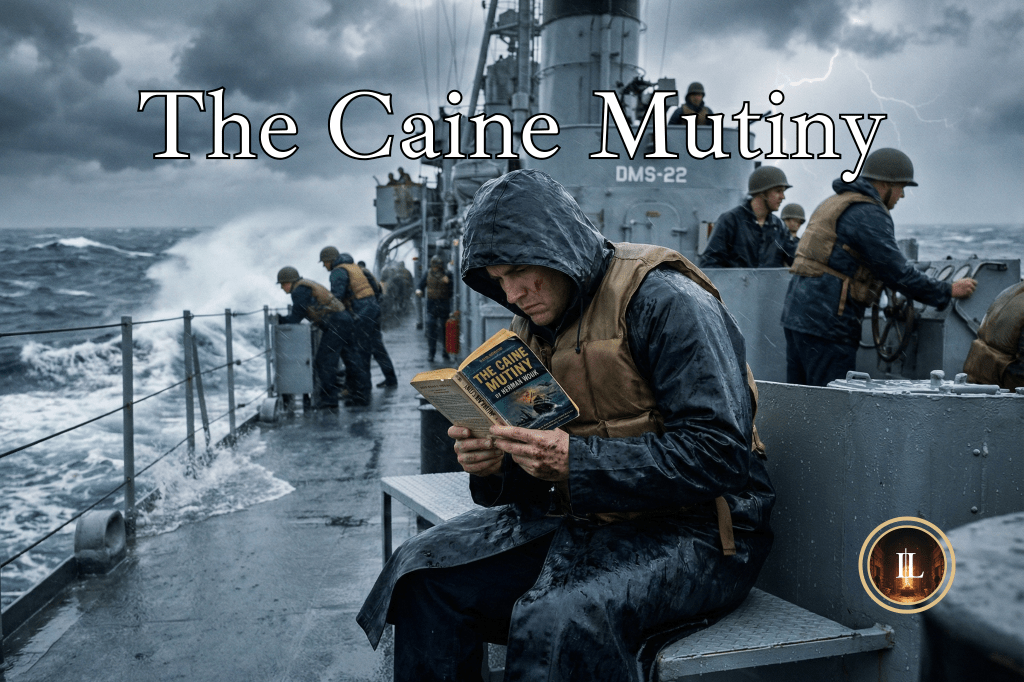
Caine duty is the kind of duty that counts. The high-powered stuff just sets the date and place of the victory won by the Caine.
In Moby Dick, Melville introduces us to a character named Queequeg. He handles harpoons better than any other seaman. He hails from an island in the South Pacific; a prince of his culture, strong with tatoos covering his body. Truly an uncivilized savage by any estimation of Melville’s western world. And yet, Queequeg exhibits what the modern reader would call civilized qualities beyond those of his peers. Ishmael meets Queequeg at an inn where they must share a bed. Neither men chooses to endure the other in such close proximity, as Ishmael undoubtedly fears Queequeg and his non-western appearance. And yet Queequeg pleasantly surprises Ishmael with his kind and honorable nature. He behaves selflessly and bravely beyond anyone’s expectations – the epitome of nobility. They befriend each other and Ishmael suddenly realizes one cannot judge another man by their appearance.
I mention this because I find Captain Queeg’s name exceptionally odd.
Wouk guides the reader through a maturation process right alongside his characters, particularly Willie Keith; a young man joining the navy in order to avoid the army, whose mother still sees him as a helpless child, who nearly fails out of navy school and eventually joins a dicrepit ship called the Caine. He lacks purpose and conviction; a cheap entertainment piano player and hopeful academic.
Keith learns about the Navy from an aspiring author named Keefer, the half-brother of one of Keith’s roommates in school. Keefer has the Navy all figured out. Like an adolescent rebel who has read a book, he sees the truth behind the pharisaical regulations of the Navy. Literary connections, see? The Caine does not coincidentally don the name of the Bible’s first murderer. It holds a commune of misfits and outcasts and likely carries a visage of the black heart of the sea. Like youth, one may love it while they can’t wait for the day to leave it. If they stay on it, what kind of life do they miss?
When Captain Queeg joins the Caine, Wouk casually allows his rigid regulation doctrine to run unchecked. The cruel punishments for slight mistakes, the expectation of perfection, the obsession with his own flawless interpretations of reality, his retaliation and scapegoating; all culminate to a mutiny during a typhoon.
Consider how the mutiny occurs during a typhoon rather than a battle. The book takes place during the latter half of World War II but Wouk chooses to raise tension and action around a natural calamity, an inevitable occurrence. The officers interpret Queeg’s inability to act reasonably, his strict adherence to orders from an authority thousands of miles away, as justification to relieve him of duty. During a storm. A time when the youth of the ship graduate into a world massively overpowering, daunting and unforgiving.
Later, the Navy conducts a court-marshall of the executive officer who cites the Articles of relieving command. Here begins one of the most entertaining court dramas I’ve read. Considering my thoughts on Queeg’s leadership as well as the law, which I know weighs heavily against the officer, I could not wait to see the verdict.
The outcome lays in the hands of a figher pilot; a man who works as a lawyer in his private life. A confident man, who understands the officer’s chances of an acquittal, of a win for him, yet hesitates to take the case. In the lawyer, the reader begins to understand the dichotomy between systemic leadership and humanity, heroism and loyalty. The possibility to win against moral justice.
His speech following the acquittal astounds me. And while some may interpret the speech, and Wouk’s sympathies, as those of a post-war generation railing against new “liberal”, arrogantly naïve milksops, I find the aftermath much more universal. As Navy careers move on after the acquital, we see the same youthful characters become the old guard. They begin to empathize with Queeg. How much of himself had he sacrificed? What manner of sternness drove him to his station?
Even at anchor, on an idle, forgotten ship, Willie experienced the strange sensations of the first days of a new captain: a shrinking of his personal identity, and a stretching out of his nerve ends to all the spaces and machinery of his ship. He was less free than before. He developed the apprehensive listening ears of a young mother; the ears listened on in his sleep; he never quite slept, not the way he had before. He had the sense of having been reduced from an individual to a sort of brain of a composite animal, the crew and ship combined. The reward for these distrubing sensations come when he walked the decks. Power seemed to flow ou of the plates into hsi body. The respectful demeanor of the officers and crew thrust him into a lonliness he had never known, but it wasn’t a frigid lonliness. Through the transparent barrier of manners came the warming unspoken word that his men liked him and believed in him.
They understand that the savage they first met, after all, contained more humanity than they realized – not perfectly honorable, romaniticized characteristics as they wanted, but flaws; fear, childhood trauma, a fragile ego, all things we share to one degree or another. Humanity nevertheless. They have no more or less strength than Queeg, though they cope with that limitation differently. Like watching a parent fall from the pedestal of god-like infallibility to the gutter of imperfection, the young officers realize that their expectations of Queeg may have been as unreasonable as his. And it only took the empty coffin of Queeg’s career to keep them afloat in the vast empty ocean of life. Just as we must remove the bias in our own perspectives to find the humanity in the savage, we must also acknowledge the humanity in a god-like position.
Or maybe Wouk wants us to believe that the Navy wins; that they successfully indoctrinate the young officers and blind them to the villainy of a ruthless captain. Like any great other, at the end, I believe he poses a great question rather than feeds us a concrete answer.
I would not qualify Queeg as a good leader. However, I would commend him for his service. I don’t believe the sailors committed a crime in saving their lives. However, I would not commend them for bravery. I do believe that we have to lead with empathy and without bias. The savage and the civilized exist within each of us and we need courage to identify them and choose which one best serves our fragile sense of self.





 The Immersion Library
Leave a comment