
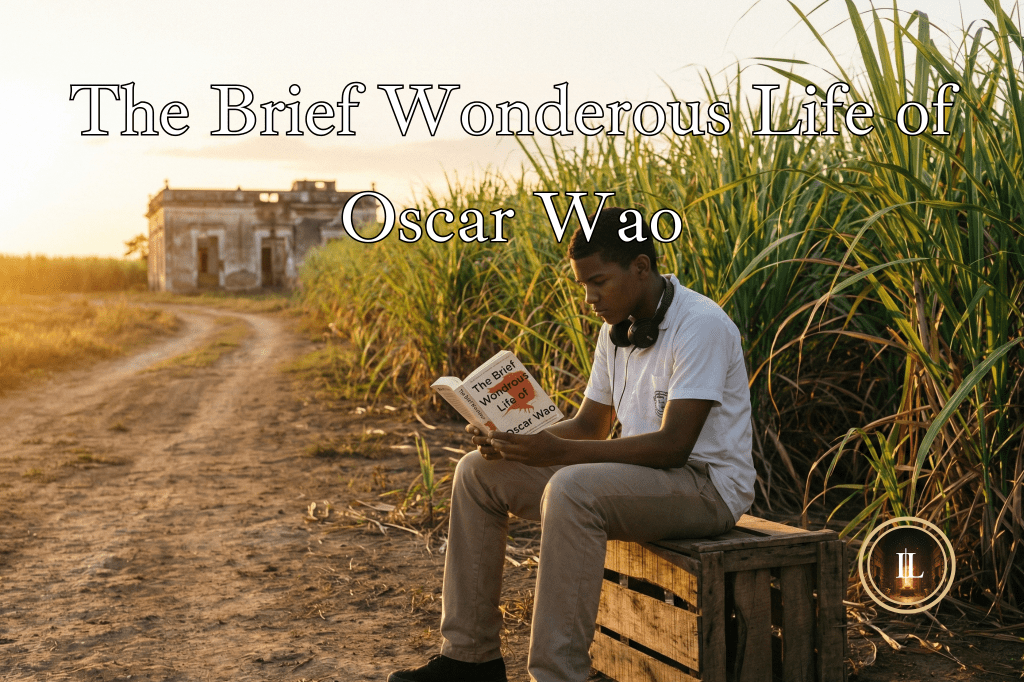
Zafa or Fukú? You tell me.
Nerd. Dork. Geek. Weirdo. We often sympathize with those unwillingly labeled as such. Yet only some of us can truly empathize. Unfortunately, more of us likely work to assimilate, at any cost, to save ourselves from bully treatment. But then we might give up on conformity when those same bullies tease us as we destroy ourselves to gain their approval. How can the nerd escape?
Consider how we define the nerd. Before thinking critically, we list their interests: academics, science fiction, indoor activities, fantasy, even success. But upon deeper reflection, we realize that we define them according to their “otherness”. Other than what?
Diáz tells the story of three generations of de Leóns from the Dominican Republic. With beautiful symmetry, the narrative arc begins with Oscar and ends with him; like a pyramid rising into the past, a see-saw balanced by generational insights. He intermixes historical footnotes with super-hero and fantasy references, mingling the literal and figurative to balance the ingrained experience with universal humanity.
Zafa or Fukú? Blessing or curse?
Review Oscar’s life and ask if his nautral interests curse him. If yes, then one needs to assess the social consequences. If one accepts those consequences of “otherness” as natural, one should then ask how they became natural. And if one determines how they became natural, perhaps one should ask when they did. And if they identify the starting point and forward, then perhaps one should ask to validate its morality.
For the Dominican Rupublic, the fukú starts with imperialism; the arrival of bullies who in their arrogance accidentally discover a New World. Imperialism begins the systemic delegitimization of native Dominican culture and instills an urgency to save oneself from the conqueror’s aggressions. Abandon yourself, only survival matters now. Then begins the self-hatred, the micro aggressions of the oppressed against each other for not having the wits or strength to survive against the aggressors.
Then the ones we commend for their wits and strength may want to do more than survive. They emulate the aggressors methods as they understand the only valid way to a free life comes through power. Now the native tyrant oppresses their own people. They destroy families. But perhaps someone in one of those families survives; blessing or curse? And perhaps that survivor feels validated by the only power she has and sees a full future life for herself embraced by the aggressor that destroyed her family – anything to rise above this contaminated muck. Yet when has an oppressor sacrificed the purity and security of their power?
As this cancerous oppression mutates and spreads down through the generations, perhaps one feels they can only escape the fukú by constantly figthting against their diseased culture and normalized ferocity of their lives. One might have to work harder and steel their heart moreso than anyone else targeting the same goals but they could look ahead as a way of surviving. Live outside the moment.
But what of the person who can’t assimilate or escape despite how much they’d like to? What happens to them? The one who cannot recode their own DNA, or mimic the normalized power lust at a macro or micro level? What recourse do they have? Do they have the strength to accept themselves and thereby accept the only fate available within this generationaly evolved system of fukú; compounded over itself like irremovable scar tissue which so many hide under fancy clothes and distract from with callous over-shouting.
Despite all his yearning, Oscar cannot change. Despite all his self-loathing, he cannot change. He can choose to accept his “otherness” and abandon conformity. Or a he can live a long life of wishing for his death; enduring his own failure to assimilate. Once he embraces himself, he can see blessings where others see curses. Own himself, and no one can harm him. Whatever fukú inflicts pails to the curse of lifelong self-hatred. Even the worst becomes a blessed escape.
Enough of the academic soapbox. Readers are simply Watchers left only to ponder the story’s implications on the universal human condition while trying to make sense of the cosmic order. But Diáz’s narrators can influence this. They impress in articulating their stories without concern for any universal meaning; with language rooted in experience rather than academic fluff. But the main narrator differentiates himself. He provides a third-person point of view from the same cultural diaspora as the de Leóns but not as a de León. He provides a balance between living a specific experience while also conveying something universal. Through his witness, he learns to see himself objectively – both his engrained systemic identity and the possibility of a free and autonomous one. He must now decide if he governs his own life or if blessings and curses do; if he has the courage to live rather than just survive, if he can accept himself along with the consequences of that choice.
Zafa or Fukú? I’ve decided. It’s me.





 The Immersion Library
Leave a comment