
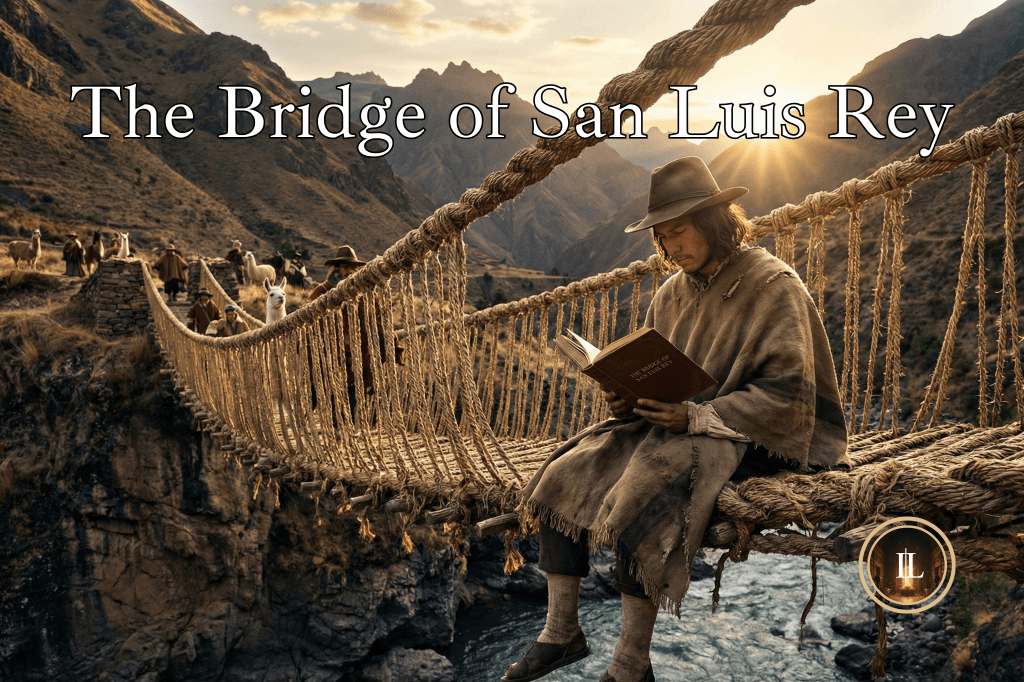
But the love will have been enough; all these impulses of love return to the love that made them. Even memory is not necessary for love. There is a land of living and a land of the dead and the bridge is love, the only survival, the only meaning.
In this short novella, Wilder manages to guide the reader to a revelation by initially setting their eyes elsewhere; like a magician exercising misdirection. From a certain perspective, one could argue that Wilder uses the same method to prove the supreme value of love as Brother Juniper does to prove the governance of God. They both collect stories but then take drastically different approaches in their analysis. Where Brother Juniper attempts to coorleate characteristics to God’s intervention in fortunes, Wilder looks at a holistic life to see the meaning of love.
I believe Wilder ultimately asks, “What matters?” Good things happen to bad people and bad things happen to good people. If God bestows fortune and misfortune on someone’s life based on their choices, does this not imply an ability to control our own destiny by cointrolling our actions? Do we fear showing doubt in our faith if we relieve God of this power? Moreover, would God rather have us focus solely on pleasing him – to put coin after coin in the vending machine of life – or on loving each other? Do we seek fortunes, or an enriched life through love and relationships?
Wilder presents individual narratives about very unique people who live very different lives. I admit I found myself qualifying the various elements of their lives. What do they have in common? How do they differ? Because Wilder introduces Brother Juniper’s proposal first, I glided gracefully into the judges seat to make my analysis alongside him. I discovered that each person has love, loses it in some capacity, experiences loneliness, and even redemption before random catastrophe strikes. I doubt the church would canonize any of these people as saints nor do I think anyone would condemn them as heathens. They simply experience their lives and cope with them in the best way they can. I understand why this would confound Brother Juniper and motivate him to find a hidden secret that reveals the God’s logical dispensation of fortunes and mishap.
Yet as the stories end, the reader not only loses their faith in Brother Juniper’s ability to reveal the secret but begins to ask if it matters. Does a secret exist at all? Imagine if his analysis proves how our actions, beliefs and choices control random “acts of God”. I fear we would lose our ability for compassion, to care for those who suffer, to forgive, to allow others to enrich our lives through love. I imagine God would want people to live with these qualities rather than rest in the certain knowledge of his existence and our ability to control his wrath.
Ultimately, Wilder explores a poignant question in a short novella and, I think, articulates his conclusions quite well. I consider all the ways he could have explored this question; lecture us or use it as an opportunity to credit himself with a great American novel. But something about allegory certainly works and he let the question guide his art rather than vice versa.



 The Immersion Library
Leave a comment