
Remember this: not all ambiguities need be resolved, nene.
On the cover of this edition one finds an illustration of a hyena peering out from behind a black drape (maybe?) in which, given the correct lighting, one can see their own reflection. Under the hyena’s head the phrase “A ИOΛƎ⅂”. I feel this represents my general thoughts on this book. One sees this depiction of “A NOVEL” and immediately asks, “Why did Torres choose to type it this way?” Is it supposed to be a mutated depiction of the form? This must be an artistic choice.
Everything about this book challenges the limits of its form in much the same way its characters challenge the limits imposed on a life. The section breaks, the illustrations, the stylization and prose formatting…it all fascinates me because I believe Torres made these choices conctientiously and meticulously. I do not feel that he leaves a puzzle for readers, simply the best representation of his ideas and feelings using the artistic and imaginitive tools at his disposal. The book itself stands out as a beautiful “other”.
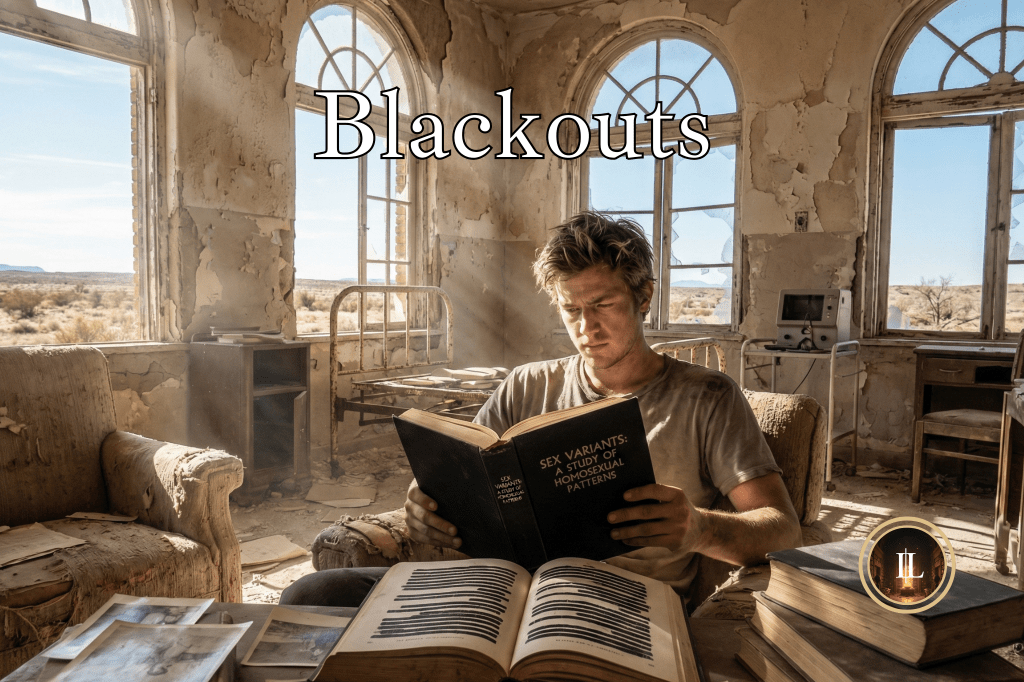
Torres presents two men exploring each other, sharing stories, histories, pains and elations. Nearly the entire book takes place in one room yet the reader journeys through their stories. While Torres leaves his form choices open to interpretation, he clearly expounds on his central theme of erasure. Quite literally, in a book detailing experimental research on homosexuals, someone has blacked out certain words and lines to transform the text into creative poems. Censure of this research text, intended to uncover the nature of homosexuality, ironically, transforms it into a truer essence of the victims.
While this is undoubtedly a beautiful symbolic act, the theme of erasure goes further into fading memories, blacked out lines in these mens’ histories and personalities as American culture seeks to tell their story for them, omitting and adding elements with which they can find comfort. We watch these men battle for their own identity, get lost in their own lives, all in an attempt to reclaim them. Even to each other, in a kind of Socratic dialogue with Plato, they go so far as to relay each others’ histories as movie scripts, always a veil between true vulnerablity and identity.
A bit of a trick, no? If, say , no adult has ever spoken postively, or even neutrally about homosexuality, and yet they referenced it frequently enough, in jokes, and questions, and hostile accusations, it would be very hard for an effeminate boy of seventeen, a boy like you were, say, to desire his own desires, would it not?
Ultimately, their lives coalesce around an idea: “To be released of the want of the want of release.” But if this happens, what do they lose? And who am I to judge? However Juan wants to tell his story, our role as reader is to sit with him and listen. Whatever our own history, we can share it in a way that best exposes our truth.
All endings are messy endings, nene. All that lies ahead is the great forgetting. The blackouts will come very quickly now. And the body…Nene, all ends are messy.



 The Immersion Library
Leave a comment