
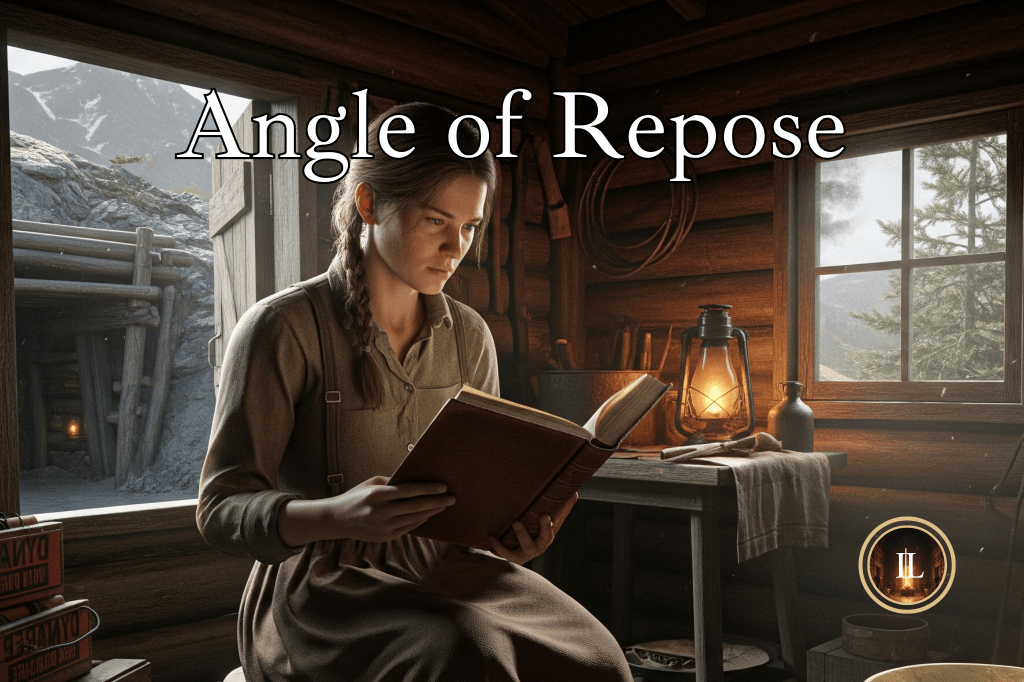
Why then am I spending all this effort trying to understand my grandparents’ lives? What am I talking and organizing all this for? Why do I hire this girl to make my talking real by typing it off the tapes? Why do I drive my drifts and tunnels toward the hidden lode of Susan Ward’s woe? Is it love and sympathy that makes me think myself capable of reconstructing these lives, or am I, Nemesis in a wheelchair, bent on proving something – perhaps that not even gentility and integrity are proof against the corosions of human weakness, human treachery, human disappointment, human inability to forget?
Early in the novel, Lyman Ward discusses his efforts in writing Susan Ward’s biography with his son who doesn’t think the modern public would find her life interesting. The conversation sounds like a clash of generations, one presumptuous and focused on the future, the other at the end of his own and looking to the past for resolution. Lyman cannot tell his son why he dedicates so much time to studying his grandmother’s history because, in truth, he doesn’t yet know. Instead, his response sounds like the stereotypical old man telling kids to get off his lawn. He has a frustrated tone, with the modern culture and its abandonment of conventional values, but these circumstantial reasons do not fully satisfy the question. The honest and true answer will reveal itself when his vantage point changes.
The brilliance of this novel shines through in Stegner’s ability to coalesce complex dimensionality into a seemingly simple idea: an old, disabled grandson living in the modern era writing his grandmother’s biography and her trials in the western frontier. Simply stated, not as simply composed.
Much like Nathan Zuckerman in American Pastoral, Lyman Ward weaves the written biography into his own narrative in Angle of Repose, removing walls between himself, the fictional and the real reader. This dimensionality exposes Lyman’s developing understanding of his own character and how he changes through his exploration of his grandparents’ life. Stegner could have simply chosen a third-person perspective and told Susan Ward’s story with no mention of Lyman. He could still expose many themes exemplified by the spirit of the American frontier. Yet he chose to add this narrative dimensionality of a grandson’s research and act of writing the biography the real reader reads. Also, he uses primary sources and intersperses them within the narrative, so the reader has yet another voice, or angle, on the story.
Lyman uses Susan’s letters to piece together past events. He uses what she says but, unfortunately, must speculate on certain events due to what she does not say. The letters reveal a great deal about her character which helps Lyman make reasonable assumptions about these gaps in events. Yet the reader quickly suspects Lyman of interposing his own hopes, respects and assumptions into those gaps as well, as evident by his arguments with his caretakers and children.
Stegner uses time as a fascinating dimension within the narrative. He chooses to craft Lyman as an aging divorced amputee with children. Generationally, he bridges a gap between the future and past. His stage in life, however, showcases a natural passion for being that bridge. As a retired history professor, the past captivates him, but as a man who has decided that he has no real future to chase, he looks to a past of which he already knows the future. He longs to experience his grandparents’ venture into the unknown, while already knowing their ending. In this way, time loses its linear identity and becomes a single state with different vantage points as well as allowing Lyman to focus his viewpoint on the aforementioned question.
This story is not about the American West. It does speculate and investigate the spirit of her pioneers which serves to bolster a broader relationship theme. Again, we have another layer of dimensionality. Two lives merge as do two worlds – husband and wife as well as East and West. One exhibits the circumstantial challenges with clashing worlds; one developed and another developing. But from another viewpoint, one notices that the Ward challenges arise not from circumstances but from differing ambitions, differing values, and differing needs. Susan longs for the developed culture and civilization of the East whereas Oliver yearns to create the West.
There must be some other possibility than death or lifelong penance…I am sure she meant some meeting, some intersection of lines; and some cowardly, hopeful geometer in my brain tells me it is the angle of which two lines prop each other up, the leaning-together from the vertical which produces the false arch. For lack of a keystone, the false arch may be as much as one can expect in this life. Only the very lucky discover the keystone.
If time moves horizontally, and human lives stand vertically, they must intersect. And here we have our angles. We must consider the title. Repose implies peace and accomplished satisfaction. Oliver seems to chase his repose, providing for happy family through his own ambitious accomplishments. And yet, his engineering projects do not bring this happiness. In fact, in a linear sense, this goal is not a destination, but an experience in the present.
Like everything here, it’s large and raw. It is for the future, it sacrifices the present for what is to come.
Lyman ponders human weakness, particularly in Susan, who denies her own repose to support and accommodate Oliver’s dream. However, I would ask Lyman: how much can we reasonably ask Susan, who is no more or less human than Oliver, to remain steadfast in her support? If she fails, is that not understandable? Will she only gain respect if she proves to be superhuman? The spirit of the West will test the best and often prove them wanting. And Lyman’s grandparents’ repose appears when they give up; not on the West, or their children, or their responsibilities, but on each other.
Has Lyman found his repose in giving up on himself and his relationships? Lyman admits that he wrestles with his relationship choices in his own life as well as with his own nature and seeks to understand this inner conflict through studying his grandparents. That is the answer to the original question. Whereas the American Dream affords her citizens a chance to abandon their past and build a life and identity free of roots, what do those citizens do when they don’t see a future? Lyman peers in the other direction to make sense of what has become of his life, his world and himself, which enables him to decide his future. While we journey with Susan and Oliver Ward through America, in truth, we travel alongside Lyman Ward through his self-discovery.



 The Immersion Library
Leave a comment