
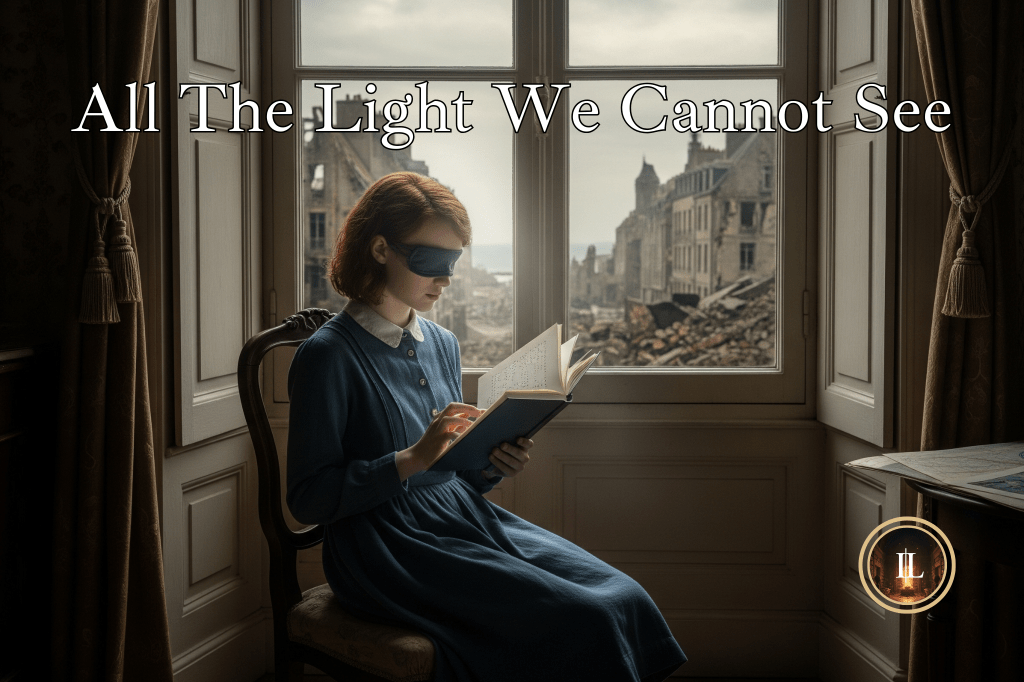
She says, ‘When I lost my sight, Werner, people said I was brave. When my father left, people said I was brave. But it is not bravery; I have no choice. I wake up and live my life. Don’t you do the same?’ He says, ‘Not in years. But today. Today maybe I did.’
Simply beautiful. Two parallel stories, constructed in small digestible pieces that focus the reader on what matters. Even when Doerr talks about violent bombardments, one remembers innocence. Even when he talks about assimilation, one remembers individual dreams. Even when he talks about hiding and abandonment, one remembers connectivity. And even when he talks about despair, one remembers a flame inside the sea.
Two children, one an inquisitive German orphan boy who dreams only of escaping the mines and becoming a great engineer; the other a blind French girl beloved by her father and enraptured by her novels. Strangers on opposing sides in great war, each yearning to thrive, each swallowed by the world around them; stifled by an abysmal sea impossible to escape.
Rather quickly, one notices the numerous connected symbols and themes throughout the novel. Marie-Laure’s snails, radio and books, geological pressure and hidden gems, and, of course, light. While the reader may recognize these things quickly, Doerr carefully and patiently develops them to maturity into human connectivity. Amidst monstrous efforts to disconnect humanity – whether by racial cleansing or violently defending invented borders – we instead witness the triumph of connectedness in small, fated occurences. Werner’s radio, the LeBlanc home in Saint-Malo, the mines and the base of the Hotel of Bees, Captain Nemo and the hidden attic, the small flame pitted against the vast sea. As the war machine envelopes the world in darkness, tiny lights always push through. In fact, the greater the machine, the more tiny lights. A futile effort to extinguish them.
Now, what is all the light we cannot see? The tiny remnants of humanity from which the machine distracts us? Sure. The radio waves and colors envisioned by the blind girl? Maybe. The world we construct in the dark tomb of our skulls? Possibly. Are we light?
And is it so hard to believe that souls might also travel those paths? That _____ and _____ and _____ and _____ might harry the sky in flocks, like egrets, like tems, like Starlings? That great shuttles of souls might fly about, faded but audible if you listen closely enough? They flow above the chimneys, ride the sidewalks, slip through your jacket and shirt and breastbone adn lungs, and pass out through the other side, the air a library and the record of every life lived, every sentence spoken, every word transmitted still reverberating within it.
We only see part of the light spectrum. And when that part of the spectrum seems enveloped in darkness, we retain our humanity by embracing the invisible lights that connect us.



 The Immersion Library
Leave a comment