
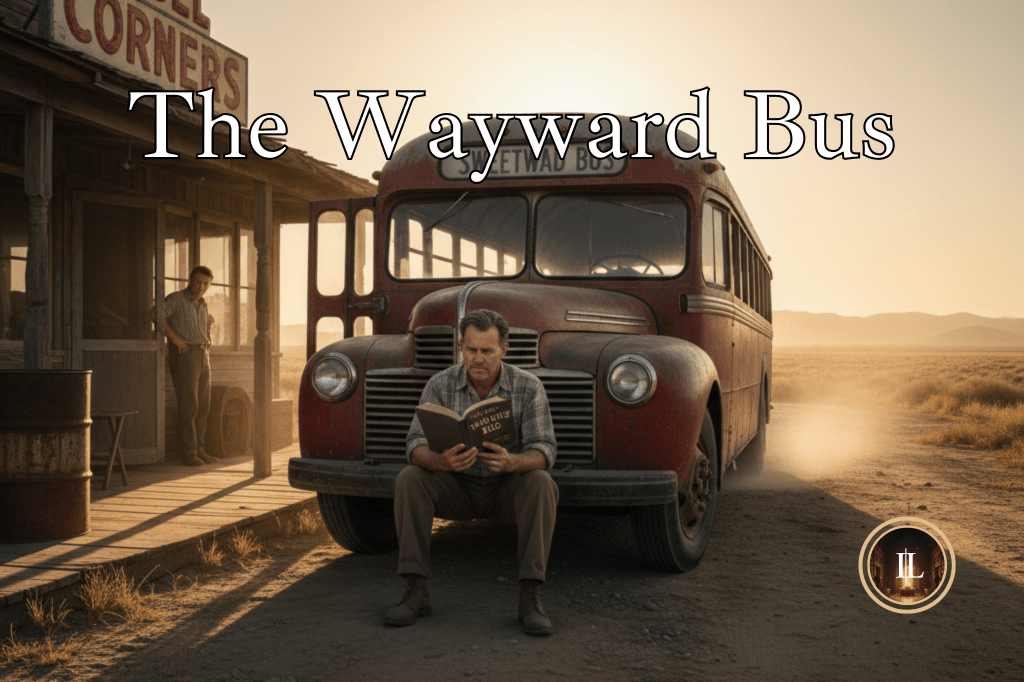
It seems to me that young people have lost their faith in America. Our ancestors had faith.
I don’t care at all about what the bus represents.
It might shine as a dumpy emblem of the American journey to either the realization or implosion of our future plans. But the story strikes me more as the common American journey not necessarily from childhood to manhood, like the universal Buldingsroman, but rather the solitary transformation to self-realization from what to who. After all, what can these characters do with a Virgil like Juan Chicroy? The prototypical guide never wavers, never falters, offers insights and leads the way. An effective guide allows the hero to transform through struggle rather than lecturing. But what if the guide does waver and falter? Perhaps if he does, the heros can delve even deeper into their primitive selves and come to a better understanding of the meaning in their lives.
Even if this all rings true, I don’t care about the bus. Steinbeck impresses with his dynamic grasp of character and in no better fashion than exemplified in The Wayward Bus. His others works provide an academic smorgasbord of analytic sweets but in this book we have a company of characters who seem to serve no purpose other than to mirror the readers very own emotional conditions.
Whether Steinbeck intended this or not, I gleaned a sharp sense of relation to these people. Each one not only reflects the emotional states of demographics sharing their circumstances but also exposes the fundamental emotional core from which they all crawl. Any reader who picks up The Wayward Bus will find themselves within its pages with near perfect likeness. They would first find the character with whom they relate but then find themselves in the shoes of the other characters with complete sympathy for their circumstances and emotions as if they share them in reality – perhaps before they even know of people who really live those circumstances.
What a talent! With ease, Steinbeck has me feeling like a middle-aged, unsatisfied and insecure woman, a confined adolescent yearning for life, a cardboard businessman and a happy-go-lucky salesman, feeling the strain of feminine beauty before infusing me with the integral masculinity which fundamentally drives me as a carrot just within my grasp.
So no, I do not care about the bus. But I haven’t read many books in which I care so deeply about the people. They are me.





 The Immersion Library
Leave a comment