
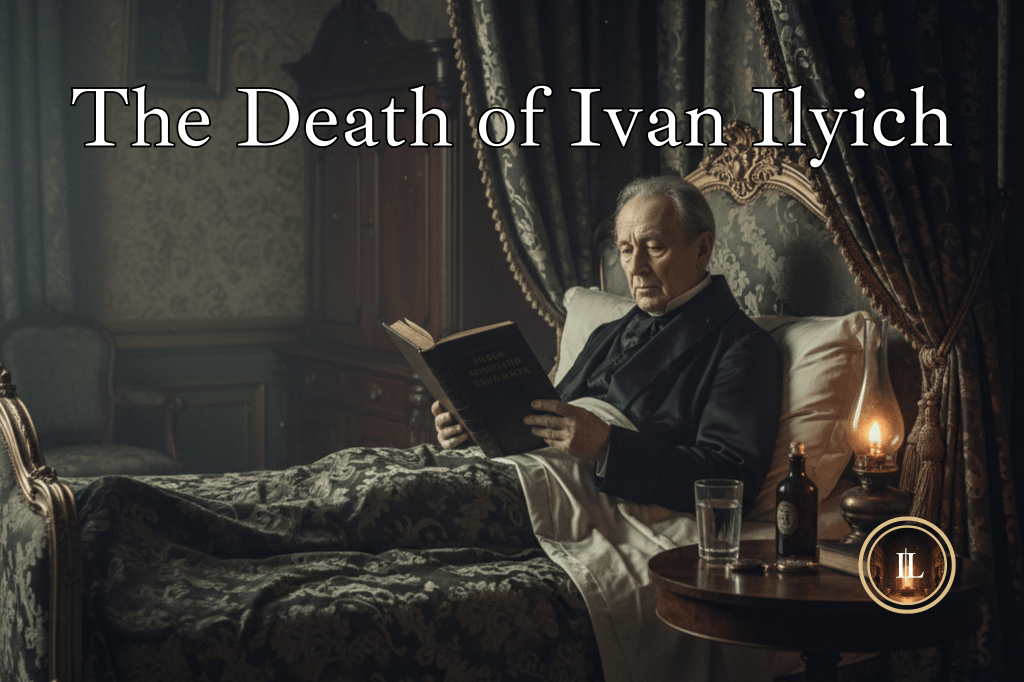
There was no deceiving himself: something terrible, new, and more important than anything before in his life, was taking place within him of which he alone was aware.
At my grandfather’s wake, my father walked me to his casket and blanketed my grandfather’s crossed hands with his own. He looked down to me with soaked eye-sockets and a serene grin and said, “They’re so cold.” During the remainder of the wake, I watched my grandmother, aunts and uncles greet guests and cordially accept condolences in a neatly organized line while the children played, diverting themselves from an interminable boredom from which they wouldn’t dare ask to be relieved.
At the funeral the next day, I cried only when my uncle did; after losing control of his incomprehensible composure.
If War and Peace is too long, The Death of Ivan Ilyich is too short. Tolstoy’s ability to compact Man’s greatest insecurity, without losing its full potency, deifies him among literati. He substitutes grand styling for natural insights and masters reason and logic instead of exclusively binding himself to them. Rather than delving directly into Ivan Ilyich’s soul and insisting on a proposition based on his findings, Tolstoy demerits Ivan’s reasoning capacity in hopes, perhaps, of clearing the litter of distractions cluttering the essence of a person’s bout with his final and omnipresent nemesis.
Death, in essence, exists outside of Man’s reasoning capacity. All experiences and knowledge stem from what exists whereas Death is to NOT exist. Can a person fathom his non-existence? Logically, it remains an impossibility as man would need to exist in order to do so. As a result, people like Ivan, ambitious aristocrats encased in their sense of youthful invincibility, ignore death and hide their rebuke for those dying and dead behind social responsibilities of cliche gestures and fraudulent sympathies. All the while they rejoice in the fact that they have eluded Death’s icy grip thanks to those who have taken their place.
I can relate. Can you? I participate in the modern western machine racing to destroy death, prolong life and distract people from its certainty. I don’t want to be around it and I don’t want it to interrupt my schedule or lifestyle.
Yet when Ivan Ilyich, among the most devout in ignoring Death, falls ill, he eventually acknowledges his imminent demise. His first astounding transformation takes place in which he resembles Tolstoy’s sentiments about Death. Like a curse afforded by genius, Death plagued Tolstoy’s thoughts. But unlike Ivan, its imminence appeared to Tolstoy without the help of an illness. Death lingered everywhere and Tolstoy saw its inevitability in everything. And for the reader, a sort of nihilistic mentality erupts from his struggle. One cannot help but sympathize with it knowing that all Ivan’s ambitions and aristocratic moves amount to nothing in the face of imminent Death.
However, to distinguish Tolstoy’s struggle with Death from this nihilistic biproduct, one must discern between mortality and death. Mortality describes the nature, limitations and essence of our existence. But mortality describes nothing about the essence of death except for the fact that it happens. Therefore, Tolstoy, plagued not necessarily by mortality but by Death, explores the essence of Death but does not promote methods, nihilistic or otherwise, of living with mortality.
After hope lingers amidst doctor visits and treatment regiments, its absence defines Ivan’s later despair at the presence of imminent death. Naturally, Ivan questions why he must suffer and die. When calming himself enough to listen either to his own thoughts or to God, he considers if his suffering and death results from having led a poor life. Since his young adult days, his life slipped into moral degeneracy as he filled it with aristocratic indulgences. But he rebukes this idea because he desires contentment in his innocence and unjust punishment – even if the above proposition is “incorrect”.
The unmentioned flaw in this stage rests in the premise that death is a result, a caused effect, and if one could simply manipulate prior circumstances the outcome would change. Of course, death is a fact; a certain and unavoidable end immune from choices and manipulated circumstances. Therefore, whether Ivan morally declined through life or not, he shared in the common progression of men toward death. Even though he naturally, but erroneously, accuses death of causing his moral anguish, Ivan can appease that anguish by rectifying his circumstances – but only for the sake of living a better life, not avoiding death.
Ivan’s final realization culminates in love. Ivan could not elude death but he could have eased, if not dissipated, his moral suffering had he lived for love of others rather than himself. The ego of a dying man may rage at death if the life belongs to him. If the life belongs to others, then his ego finds contentment.
But Tolstoy begs more.
When describing Ivan’s passing, he argues for Death’s absence! Only a light presents itself. Perhaps the essence of Death is no more than an idea; a word indicating the end of one thing when in reality a new beginning happens. The familiar personified literary phantom fades. Perhaps Death, as we fear it, does not physically exist at all. Our lives cease to continue but do we? And if we learn to live as something more than the finite physical life we lead can Death shake us? Can the end of our physical lives scare us?
Ultimately, Tolstoy did not write a manual describing the best methods of living and dying. He craftily articulates his choice to struggle with a conundrum that most people ignore. Until they too, like Ivan Ilyich, my grandfather, me and you, must face it.



 The Immersion Library
Leave a comment