
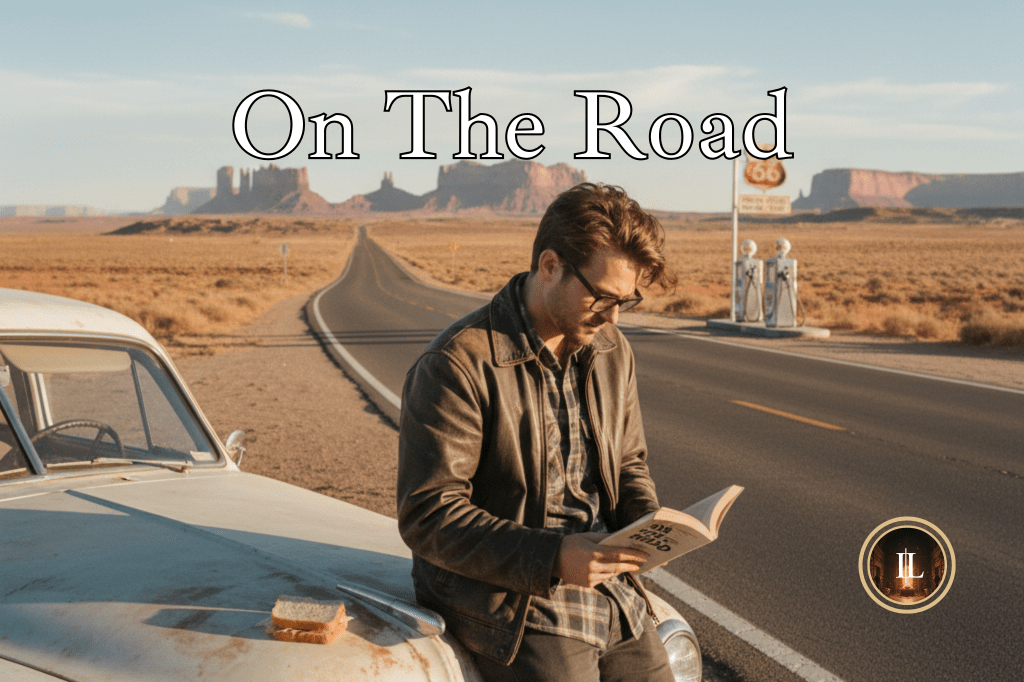
Nothing behind me, everything ahead of me, as is ever so on the road.
The beauty of Kerouac’s story is it’s timelessness, as is with all great works of art. It’s lasting power is rooted in it’s ability to speak to generations following the Beats. As political and cultural tones shift, particularly in America, it boils down to logic that a group of people may feel disillusioned – on the outside yearning to fill a void left by being beaten and prodded by social norms and expectations.
No, I don’t want a white picket fence or multi-car garage. I want to be free to roam; live as a nomad – a blank mind ready to be blown.
However, Kerouac illustrates, perhaps unintentionally, through his experiences with Dean Moriarty, that such a life and such a dream only deepens the crevice; like a dog chasing its own tail. One only feels exhausted and more “beat” – but with fantastic stories.
Of course this interpretation is not a defense of materialism, status or normality. Sal’s willingness to drop everything and follow Dean at any moment shows that he is not content with the void and won’t turn to materialistic means to fill it. But he never talks about if following Dean is actually good for Sal. Most experiences they share are through Dean’s words or actions, as if Sal is just happy to live a life he admires rather than one he enjoys. If Sal admires the life, it is only natural he admire the man who embodies it, as Sal expresses a deep understanding of Dean, as a sort of Angel.
Kerouac seems to have little, if any, shame in telling the story of his chase – and its inability to satisfy. After all, most human endeavors (even incessant reading) have the same futility in filling this void carved out by the American mainstream. So I feel “On The Road” is a breath-takingly honest depiction of the problem rather than a solution.
Nevertheless, it is a problem. Though “On The Road” may not be the answer, at least they’re looking.



 The Immersion Library
Leave a comment