
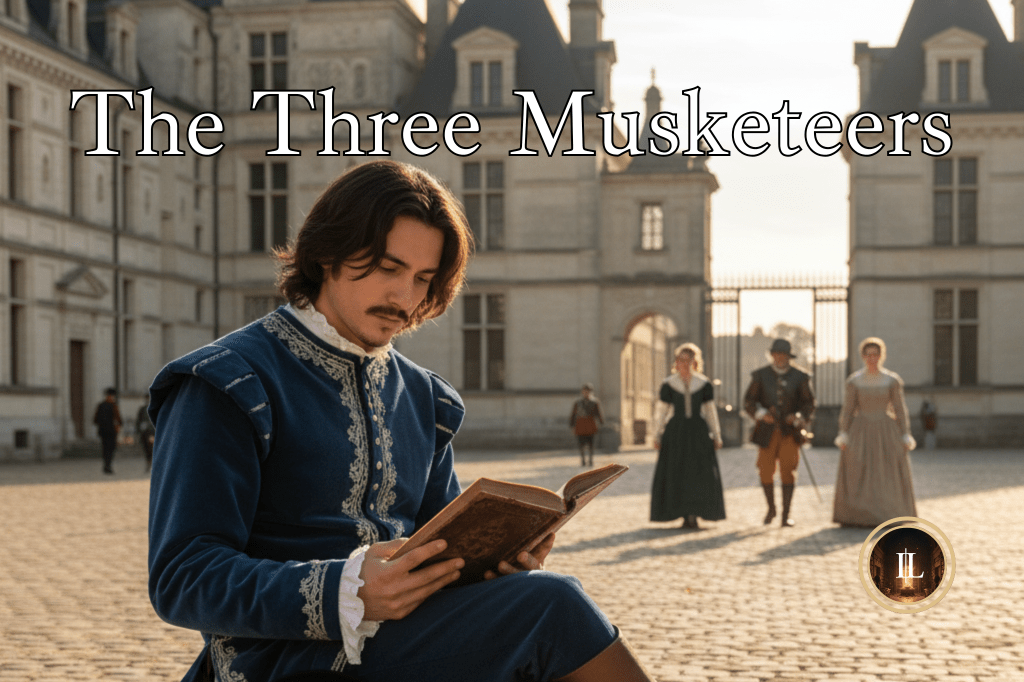
All for one and one for all.
Swashbuckling indeed.
Dumas’ tale of these honorable scoundrels merits its place in eternal literary glory. He musters all the typical facets of a Hollywood blockbuster but exploits the inherent themes developed by the characters.
Consider the title. Like The Hunchback of Notre Dame, the title misleads the reader from the real hero or center of the work. After giving some thought as to the reasoning behind this, I can only conclude that Athos, Porthos and Aramis somehow represent the pinnacle of incorruptible honor and steadfast duty to which d’Artagnan learns to aspire.
However, not one of these “good guys” exhibit a characterization without flaw. In fact, the reader will likely find some of their attitudes regarding self-glorification, women, reckless recreation, the value of life, etc. despicable. Athos drinks his past away, Porthos dives willingly into the snares of vanity and Aramis cowers into the open arms of the church when worldly threats overwhelm him. But these three never falter in their duty. Whatever their moral convictions, they never sway.
D’Artagnan, as an impressionable rookie with the gallant heart of Gascon gentry, develops like a student with unbound potential. In the service of a corrupt and spineless government, his chosen side owing only to fate, d’Artagnan must learn how to adjust and assimilate into the net of musketeers, cardinals’ guards, jealous king’s, power-abusing dukes and detestable women. The French government of King and Cardinal mirrors that of modern party-based governments with warring factions of musketeers and guards like Democrats and Republicans. Like The Illiad, government abuses power to serve their personal whims but, if you choose to read this book, are the heroes any less guilty of such an infraction?
But d’Artagnan’s education bleeds outside the realm of government service and symbolically onto the battlefield of good and evil. Milady de Winter, described as nothing short of the serpent in the Garden of Eden, battling in the arenas of convents and manipulating religious sentiments in those she seduces, ironically mirrors d’Artagnan’s own passions in vengeance, devotion and persistence in self-promotion and glorification. To distinguish between the two, the reader need only look to gender and alliance.
Yes, and I do not say that lightly.
The cardinal, to the confusion of many of his closest confidants, will not arrest the musketeers but rather thinks on how to employ them, as he had employed Milady de Winter’s passions and skills. D’Artagnan, again, joined the musketeers only because of the simple fated circumstance of his father’s childhood affiliations with M. de Treville. During the twisted Shakespearean tragedy when Milady and d’Artagnan developed a personal relationship, Dumas described d’Artagnan’s infatuation and dejection as entertainments to his self-love. As the story resolves, both characters lose something of themselves. And because of the palpable prejudices against women within the story, the reader must assume the responsibility of asking about Milady’s possible fate had she been a man. Perhaps our answer lies in d’Artagnan; as if his reckless pursuit and defense of honor and his propensity toward vengeance could be aimed at his own body.
Perhaps, after reading this book, one might take confidence in the idea that flawed but courageous men can rise to service and stand up for justice. But I would challenge the reader to defend that view after reading Dumas’ conclusion. Undoubtedly, The Three Musketeers entertains but the oftentimes satirical and hyperbolic episodes plant the idea that Dumas may consider these events silly yet terribly consequential and without hope of alteration; an interminable drama linked through the centuries.




 The Immersion Library
Leave a comment