
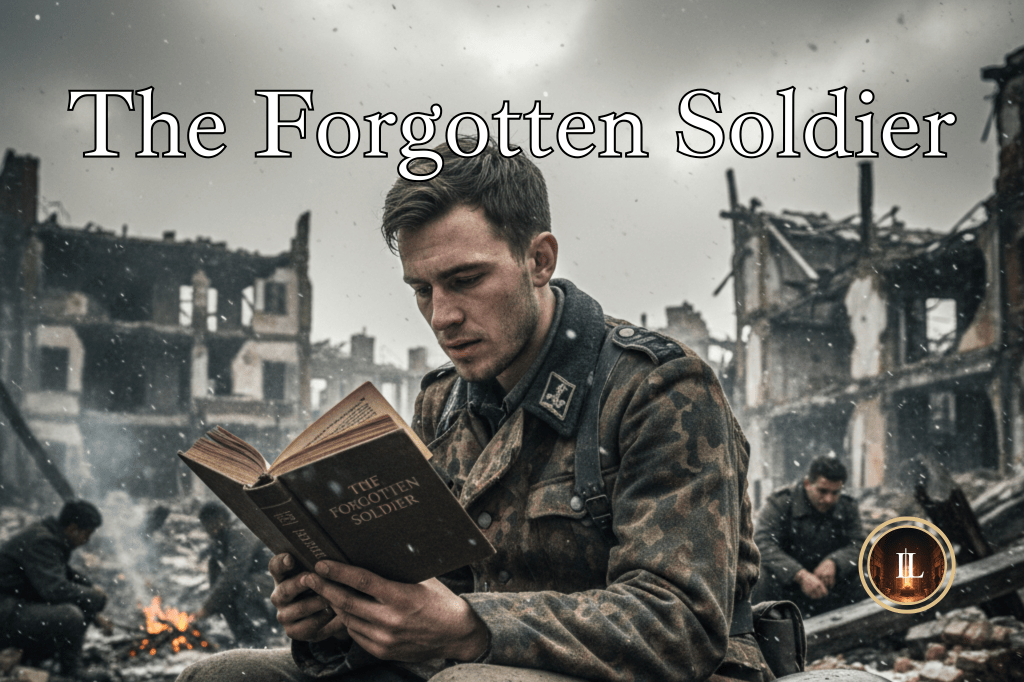
Then there was the war, and I married it because there was nothing else when I reached the age of falling in love.
Through the eyes of Guy Sajer, I have rediscovered the putrid horror of war and the interminable depth of the human soul. Such a juxtaposition concerns me. In the flowing filth of destruction, can one glimpse the shimmer of the human quality? So many people allude to war as the pinnacle of evil within human nature. Undoubtedly, the mystifying magnitude of our destructive tendencies overwhelms our vision and guides us into stereotypical cognition of ideological evil and discontent. However, does this focus distract us from the humanity of it all?
People fight wars. Hitler and Stalin and Roosevelt and Churchill had their agendas. But make no mistake, soldiers on all sides fought for one thing – their lives. Ideology burns like frail tissue paper under the fire of machine guns and anti-tank weaponry. On the field, men fight men. The war between Nationalist Socialism and democratic capitalism stayed in warm strategy rooms in the capitals. Set men against each other, and allow nature to take its course.
Ultimately, Sajer tells of a soldier’s epic psychological journey. Beginning with a fearful innocence facing interminable threats, it culminates into the carnal void of his existence. Sajer beautifully renders his story with the wisdom of his age and through the eyes of a young man faced with inhumane devastation. He offers insights into the human condition which, unfortunately, may not have surfaced outside of wartime circumstances. As the dread swelled, the man endured.
What bliss to see a man survive the depths of hell on earth!
What pride to know what the human soul can survive!
Or, perhaps, Sajer remains on those battlefields, lying face down; his nose half submerged in a block of ice which has settled in the gasp of his open mouth. Perhaps the man who now walks among us entombs a deathly void in his bosom and only hears the agonized squealing of a newborn child entering a life of suffering. The psychological impact and emotional drought of war will not leave him and no federal counseling will heal him. He has become war. And in his sojourn, we, too, feel war; our own personal decay with him at Memel and on the Dneiper, the beauty of delusion regarding a lost love, a visceral sense of isolation at home because the man who called it home was left mummified in the snow.




 The Immersion Library
Leave a comment